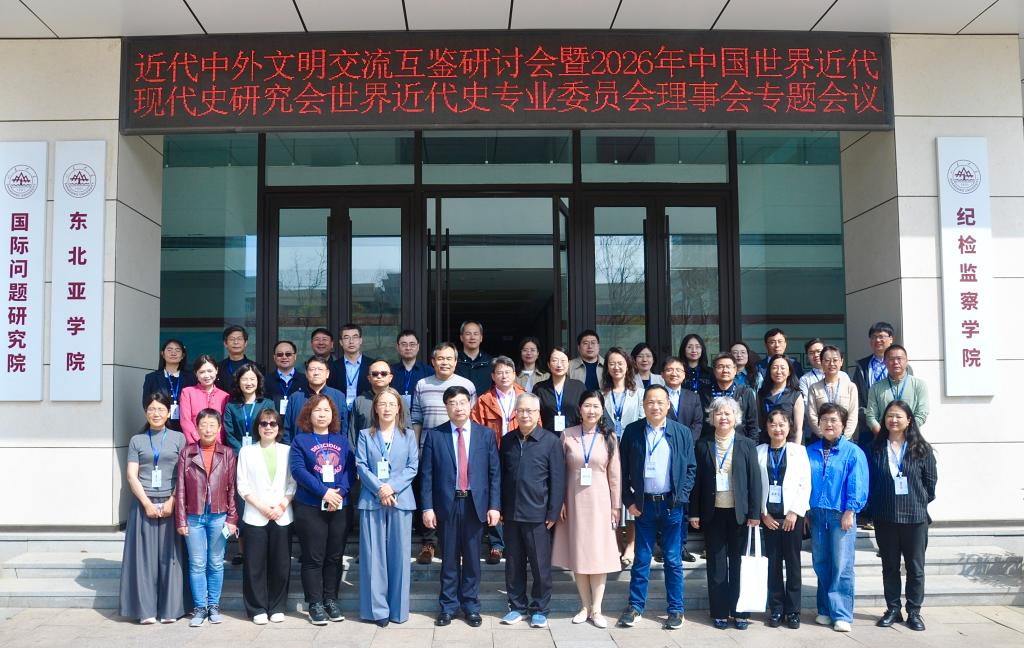
Seminar on Exchange and Mutual Learning Between Chinese and Foreign Civilizations in Modern Times & The Special Council Meeting of the Modern World History Committee, Chinese Society for Modern and Contemporary World History (2026) was held in Weihai, Shandong Province.
The opening ceremony was presided over by Miao Wei, Distinguished Professor of Shandong University and Executive Dean of the Institute of Borderland Governance, Shandong University.
Liu Changming, Dean of the School of Northeast Asia Studies, Shandong University, presented the disciplinary layout and achievements of the university in world history, Northeast Asian studies and borderland governance. Yu Jinyao, Chairman of the Modern World History Committee, Chinese Society for Modern and Contemporary World History, elaborated on the cutting-edge academic topics and key issues of the seminar.
At the keynote forum, a number of experts delivered academic presentations covering global changes, shifts in historiography, state-building, regional cognition, application of artificial intelligence and curriculum development. In parallel sessions, participating scholars conducted in-depth discussions on five themes: historical writing and historiographical theories, colonialism, empires and geopolitics, cities, spaces and social transformations, cross-cultural and cross-regional interactions, as well as innovative teaching of modern world history.
Hosted by the Modern World History Committee, Chinese Society for Modern and Contemporary World History, and co-organized by the School of History, the School of Northeast Asia Studies and the Institute of Borderland Governance of Shandong University, the seminar themed Exchange and Mutual Learning Between Chinese and Foreign Civilizations in Modern Times focused on the frontiers of world history research. It integrated theoretical research, empirical textual research and teaching practice. The seminar aims to build a vital platform for academic exchanges and dialogues among researchers of modern world history nationwide, and advance theoretical innovation, methodological breakthroughs and broader academic vision in the field.
More than 50 scholars and experts from over 30 universities, research institutions and journal publishing houses, including the Chinese Academy of Social Sciences, Zhejiang University, Nanjing University, Wuhan University, Sun Yat-sen University and Nankai University, attended the seminar